SCLC: A HISTORICAL REVIEW OF THE SOUTHERN CHRISTIAN LEADERSHIP CONFERENCE
- Nov 25, 2025
- 16 min read
A LEGAL AND MORAL ACCOUNTING
By Matt Murdock, Esq
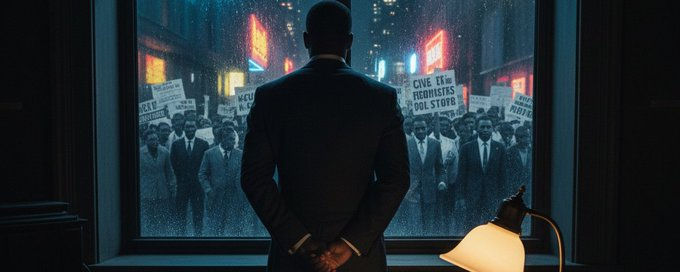
The document landed on my desk with a soft thud, a sound barely distinguishable from the frantic heartbeat of the city outside my window. Hell’s Kitchen never sleeps, and neither, it seems, does the long, tortured history of this country’s struggle with itself. I ran my fingertips over the crisp pages, feeling the slight indentation of the ink, the uniform texture of the paper. A well-put-together report. Clean. Orderly. It presents the history of the Southern Christian Leadership Conference with the kind of academic detachment that makes for good history but risks missing the soul of the thing. My job isn’t just to review facts; it's to listen for the truth that hums beneath them. It’s to weigh the legal arguments not just on the scales of precedent and statute, but on the scales of justice itself.
The city outside screams with a million stories, a chaotic symphony of sirens, arguments, and quiet desperation. It’s the same sound, in a different key, that echoed through Montgomery, Birmingham, and Selma. The sound of a people demanding to be heard. The SCLC wasn't just a historical entity; it was a legal and moral argument made manifest in the streets. It was a conspiracy, in the most righteous sense of the word - a group of people “breathing together” for a common purpose. And their purpose was to force a nation to reconcile its laws with its creed. This document is a witness statement, and I have been asked to cross-examine it, to fill in the legal and moral lacunae, and to assess the enduring weight of its testimony. Let us proceed.
Section 1: On the Forging of a Moral Force - A Jurisdictional Matter of Law vs. Justice
The report opens with the March on Washington, a quarter of a million souls gathered at the feet of Lincoln. I can almost hear it. Not just the speeches, but the sound beneath them. The rustle of 250,000 people shifting their weight, the collective intake of breath, the unified pulse of a crowd that has become a single organism with a single, non-negotiable demand. This was not a mob; it was a constitutional assembly. The report calls the SCLC a “moral authority,” but in the cold, hard calculus of the American legal system, morality is often an irrelevant variable. What the SCLC became, and what the report correctly identifies, was a “potent political force.” And in America, political force is the only thing that can compel a change in the law.
The very existence of the SCLC was predicated on a fundamental truth we lawyers sometimes forget: the law and justice are not the same thing. The SCLC’s battleground was the chasm between the two. The segregation they fought was not lawlessness; to the contrary, it was a meticulously constructed legal architecture of state and local statutes, ordinances, and court precedents stretching back to the post-Reconstruction era. The SCLC’s strategy, therefore, was not to operate outside the law, but to challenge it directly through the doctrine of civil disobedience. This is a concept often misunderstood as mere law-breaking. Black’s Law Dictionary defines it as “[a]n intentional, nonviolent, public refusal to obey a law, usu. on the ground that the law is unjust.” Black’s Law Dictionary 300 (11th ed. 2019).
Dr. King, in his “Letter from Birmingham Jail,” provided the legal and moral framework for this entire enterprise. He argued, drawing from St. Augustine and Aquinas, that there are two types of laws: just and unjust. “An unjust law,” King wrote, “is a code that a numerical or power majority group compels a minority group to obey but does not make binding on itself. This is difference made legal.” He was not just a preacher; he was a brilliant legal theorist. He asserted that one has not only a right but a moral responsibility to disobey unjust laws, but to do so openly, lovingly, and with a willingness to accept the penalty. By accepting the penalty, the jail time, the beatings, the dogs, the SCLC and its foot soldiers transformed their arrests from criminal acts into the highest form of respect for the rule of law, exposing the injustice of the law itself. They weren't breaking the law; they were challenging its legitimacy in the court of public opinion and, ultimately, in the court of federal jurisdiction.
The report’s assertion that the SCLC’s goal was to “redeem the soul of America” is the absolute truth. From a legal perspective, this meant forcing the nation to honor the promissory notes of the 13th, 14th, and 15th Amendments, amendments whose guarantees of freedom, due process, and equal protection had been systematically nullified by a century of cynical court rulings and state-sponsored terrorism. The SCLC’s campaigns were not just protests; they were acts of constitutional reclamation.
Section 2: The Crucible of Montgomery - Establishing Standing and Precedent
Every good legal argument needs a test case, a proof of concept. Montgomery was exactly that. The report lays out the facts well, but the legal significance bears deeper examination. The arrest of Rosa Parks was the inciting incident, the legal trigger. But the Montgomery Improvement Association (MIA) was the true innovation.
The report correctly notes the stunning logistical success of the 381-day boycott and its carpool system. But consider the legal peril this system operated under. The city government didn’t just sit back and watch its bus revenue evaporate. They weaponized the law. They used every tool at their disposal to crush the boycott. For example, city officials pressured insurance companies to cancel the policies on the carpool’s station wagons. The MIA, in a brilliant countermove, secured insurance from Lloyd’s of London, a firm beyond the reach of Alabama’s political pressure. This wasn’t just good organizing; it was sophisticated legal and financial maneuvering.
Furthermore, the city invoked an old, obscure anti-boycotting statute to indict Dr. King and nearly one hundred other MIA leaders on charges of conspiracy. The state’s theory was that the MIA was engaged in an illegal restraint of trade. Think about the sheer cynicism of that. A legal tool designed to prevent anti-competitive business practices was being twisted to criminalize a protest against the denial of fundamental human dignity. King was convicted, but the conviction backfired spectacularly, turning a local protest into a national story and a local pastor into a national figure.
But the ultimate victory didn’t come from the boycott itself. Economic pressure can bend, but it often cannot break, a deeply entrenched legal system. The victory came, as it so often must, from the federal courts. While the boycott raged on, a parallel legal battle was being waged. On February 1, 1956, attorneys Fred Gray and Charles D. Langford filed a federal civil lawsuit on behalf of four Black women, Aurelia S. Browder, Susie McDonald, Claudette Colvin, and Mary Louise Smith, who had been victims of the bus segregation policy. The case was Browder v. Gayle, 142 F. Supp. 707 (M.D. Ala. 1956).
The legal strategy in Browder was masterful. Instead of just challenging the application of segregation, the attorneys attacked its constitutional foundation. They argued that the bus segregation ordinances violated the Due Process and Equal Protection Clauses of the Fourteenth Amendment. The defense, representing the city of Montgomery, relied on the 1896 precedent of Plessy v. Ferguson, 163 U.S. 537 (1896), which had established the infamous “separate but equal” doctrine. But the MIA’s lawyers argued that the Supreme Court’s 1954 decision in Brown v. Board of Education of Topeka, 347 U.S. 483 (1954), while specifically about education, had rendered the logic of Plessy obsolete. If separate was inherently unequal in schools, how could it be anything but unequal on a public bus?
On June 5, 1956, a three-judge panel of the U.S. District Court for the Middle District of Alabama ruled 2-1 in favor of the plaintiffs. The majority opinion declared, “We hold that the statutes and ordinances requiring segregation of the white and colored races on the motor buses of a common carrier of passengers in the City of Montgomery and its police jurisdiction violate the due process and equal protection of the law clauses of the Fourteenth Amendment to the Constitution of the United States.” Browder, 142 F. Supp. at 717. The city appealed directly to the U.S. Supreme Court, which, on November 13, 1956, affirmed the district court’s ruling without a written opinion. Gayle v. Browder, 352 U.S. 903 (1956).
The MIA’s success in Montgomery was therefore twofold. In the streets, it established the moral and tactical precedent for sustained, disciplined, mass nonviolent action. In the courts, it established the legal precedent that the logic of Brown v. Board extended beyond education to public transportation, effectively gutting Plessy in yet another sphere of public life. This dual victory was the essential blueprint for the SCLC.
Section 3: The Founding of a Southern Conscience - A Brilliant Corporate and Constitutional Structure
The creation of the SCLC was a stroke of strategic genius, and the report touches on the key reason why: its organizational structure. To fully appreciate this, you have to understand the legal war being waged against the NAACP at the time. Southern states, particularly Alabama, were engaged in a campaign of “litigation-based harassment” designed to bleed the NAACP dry and shut it down.
The primary legal weapon was the demand for membership lists. In NAACP v. Alabama ex rel. Patterson, 357 U.S. 449 (1958), the state of Alabama sought a court order compelling the NAACP to turn over its lists of rank-and-file members. The state’s justification was a statute requiring out-of-state corporations to disclose certain information. But the true purpose was transparent: to enable economic reprisal and physical violence against NAACP members by the White Citizens' Councils and the Ku Klux Klan. The heartbeat of every person on that list would have been a frantic drum of fear. The Supreme Court, in a landmark decision, recognized that compelled disclosure of membership in this context would have a chilling effect on the First Amendment right to freedom of association. Justice Harlan wrote for a unanimous court that “inviolability of privacy in group association may in many circumstances be indispensable to preservation of freedom of association, particularly where a group espouses dissident beliefs.” Id. at 462.
While the NAACP was fighting and ultimately winning this battle, the SCLC’s founders, including the brilliant Bayard Rustin, devised a structure that rendered the entire issue moot. By creating the SCLC as an “umbrella organization of affiliates” rather than a membership-based organization, they created a legal firewall. The SCLC didn’t have individual members whose names could be demanded. Its affiliates were local churches and community organizations. For a state to get a list of SCLC “members,” it would have to demand the membership rolls of every Black church in the South.
This was legally and politically brilliant for two reasons. First, it was a decentralized model. An injunction against an affiliate in Birmingham didn't stop the work of an affiliate in Tallahassee. It made the movement resilient, like a hydra. Second, it wrapped the SCLC’s political activities in the sacrosanct protection of the First Amendment’s Free Exercise Clause. An attack on the SCLC was, by design, an attack on the Black church itself. The sound of a state attorney trying to explain to a federal judge why he was subpoenaing a church’s prayer group list is the sound of a losing argument. This structure allowed the movement to create the “one-two punch” the report describes: the NAACP fighting a brilliant war of attrition in the courts, while the SCLC fought a revolutionary war for hearts and minds in the streets, all while being legally shielded by its own clever corporate design.
Section 4: The Architects of the Movement - Assigning Legal Roles
A successful legal campaign requires a team with diverse skills. The SCLC’s leadership was a master-class in this principle. Each founder played a distinct, essential role in the legal and moral drama.
Dr. Martin Luther King, Jr.: He was the Chief Theologian and Lead Defendant. His role was to articulate the philosophical and legal justification for the movement, as he did so powerfully in the “Letter from Birmingham Jail.” But he was also the man who put his own body and liberty on the line. Every time he marched, he knew he was inviting arrest. He became the public face of the movement’s liability, the primary target of every trumped-up charge and politically motivated prosecution. His willingness to be the lead defendant gave courage to thousands of others to risk the same.
Rev. Ralph David Abernathy: He was the Managing Partner. While King was the visionary, Abernathy was the man who kept the firm running. I can hear him now, on the phone with the bail bondsman, authorizing funds from the SCLC treasury, coordinating with local lawyers, making sure the families of those in jail were cared for. This is the unglamorous, essential work of any sustained legal fight. Without an Abernathy, the grand vision of a King cannot be executed. He was the keeper of the logistics, the man who ensured the moral army had its supplies.
Rev. Fred L. Shuttlesworth: He was the Indispensable Plaintiff. A good lawsuit needs a plaintiff with standing, someone who has suffered a direct injury. Shuttlesworth, by his sheer, unbelievable courage, made himself the perfect plaintiff over and over again. He was bombed, beaten, and arrested. Each act of violence against him was not just a personal tragedy; it was a fresh cause of action. It was evidence. It was a clear, undeniable demonstration of the unconstitutional brutality of the Birmingham regime. His body was a living, breathing affidavit testifying to the need for federal intervention. It was his formal invitation that provided the SCLC with the legal and moral standing to enter the Birmingham campaign.
Bayard Rustin: He was the Chief Strategist and Architect of the Conspiracy. I use the word “conspiracy” in its purely legal sense, an agreement between two or more persons to commit an act. Rustin was the one who drew up the plans. The March on Washington was his masterpiece, a logistical feat that required navigating a labyrinth of permits, jurisdictional squabbles between D.C. and federal police, and immense security concerns. He designed the nonviolent workshops that were, in essence, training seminars on how to build a legal case through protest. The fact that he was forced into the background because of his sexuality and past political associations is a stain on the movement and a testament to the suffocating political realities of the era. The quiet, pragmatic whispers that sidelined one of their most brilliant minds are a sound I know all too well. It’s the sound of compromise born of fear.
Section 5: The Arc of Confrontation - Weaponizing the First Amendment
The campaigns from 1960 to 1968 were not random protests. They were carefully staged legal dramas designed to provoke a crisis that would compel a federal response.
Birmingham (1963): This was the SCLC’s most audacious legal gambit. The report details the events, but the legal fulcrum was the ex parte injunction obtained by the city from a state court, prohibiting King, Shuttlesworth, and others from engaging in any form of protest. This presented King with a terrible choice. He could obey a court order that was, on its face, a transparently unconstitutional suppression of First Amendment rights to speech and assembly. Or he could disobey it and practice what he preached. He chose the latter.
His arrest led to a series of legal battles that culminated in Walker v. City of Birmingham, 388 U.S. 307 (1967). In a decision that still echoes with a hollow thud of injustice, the U.S. Supreme Court ruled 5-4 against King and the other petitioners. The majority, led by Justice Stewart, held that even if the injunction was unconstitutional, the petitioners were obligated to challenge it in court before violating it. They could not resort to “self-help.” This was a deeply problematic ruling. The very nature of an ex parte injunction is that it is issued without the other party present. The SCLC had no opportunity to challenge it before it went into effect. The Court’s decision essentially validated the use of procedurally dubious injunctions to shut down legitimate protest. It was a bitter legal defeat, but it came long after the SCLC had won a resounding moral and political victory. The images from Birmingham, the dogs, the fire hoses, had already done their work, creating the unstoppable political momentum for the Civil Rights Act.
Selma (1965): If Birmingham was about public accommodations, Selma was about the most fundamental right in a democracy: the right to vote. “Bloody Sunday” was a legal atrocity. It was a mass assault, under color of law, by agents of the state against citizens peacefully exercising their First Amendment right to petition the government for a redress of grievances.
The legal response to Bloody Sunday is one of the judiciary’s finest moments. SCLC attorneys went to the federal court of Judge Frank M. Johnson, Jr., a man whose heartbeat was steady with courage despite constant threats and ostracism. They sought an injunction to prevent Governor Wallace and state troopers from blocking the planned march to Montgomery. In his ruling in Williams v. Wallace, 240 F. Supp. 100 (M.D. Ala. 1965), Judge Johnson did not just grant the injunction; he wrote a powerful defense of the right to protest. He declared that the marchers’ right to petition their government was “unimpaired by the likelihood that the exercise of that right may even ‘incite to anger and dispute.’” Id. at 106. He weighed the inconvenience to public order against the massive, systematic denial of a fundamental constitutional right, and he found the balance overwhelmingly in favor of the marchers. He effectively federalized the protest, ordering the state of Alabama not only to stand down but to provide protection for the march. That ruling was the legal bridge from Selma to Montgomery, and from Montgomery to the Voting Rights Act.
Section 6: Legislative Triumphs - Codifying the Revolution
The streets create the pressure; the legislature codifies the victory. The report correctly links the SCLC’s campaigns directly to the two great legislative achievements of the era.
The Civil Rights Act of 1964, Pub. L. No. 88-352, 78 Stat. 241: This was the direct legal answer to Birmingham. Title II of the act, which outlawed discrimination in public accommodations, was aimed squarely at the lunch counters, hotels, and theaters the SCLC had targeted. Its legal basis was the Constitution’s Commerce Clause, a clever strategy that allowed federal regulation of what had previously been considered local business matters. Title VII, which outlawed employment discrimination, was a response to the “Jobs” portion of the March on Washington’s demand for “Jobs and Freedom.”
The Voting Rights Act of 1965, Pub. L. No. 89-110, 89 Stat. 437: This was the direct legal answer to Selma. It was, and is, one of the most powerful pieces of federal legislation ever passed. Its genius lay in two key provisions, which the report alludes to but which deserve specific legal attention. Section 4 contained the “coverage formula,” which identified jurisdictions with a history of using tests or devices to suppress voting. Section 5 was the enforcement mechanism, the heart of the Act. It required those “covered jurisdictions” to obtain “preclearance” from the U.S. Department of Justice or a federal court before making any changes to their voting laws or procedures. This shifted the burden of proof. No longer did Black citizens have to sue after the fact to prove a law was discriminatory; the state had to prove, beforehand, that it was not.
For nearly fifty years, this provision worked. It was the federal sentinel standing guard over the ballot box in places where, for a century, it had been locked. And then came the sound I will never forget, the quiet, academic, devastatingly effective sound of a gavel striking down progress. In Shelby County v. Holder, 570 U.S. 529 (2013), a 5-4 majority of the Supreme Court struck down the coverage formula in Section 4 as unconstitutional. The Chief Justice, writing for the majority, argued that the formula was based on “40-year-old facts that have no logical relationship to the present day.” Id. at 557. In essence, the Court decided that the law had worked so well that it was no longer needed.
This was a catastrophic act of judicial activism masquerading as restraint. It was like declaring a patient cured and throwing away their medicine while the disease was merely in remission. The immediate result was a flood of voter suppression laws in precisely the jurisdictions that had previously been covered, voter ID laws, cuts to early voting, purges of voter rolls. The fight that the SCLC waged on the Edmund Pettus Bridge is now being waged again, not with clubs and tear gas, but with the quiet, bureaucratic violence of a thousand legislative cuts. The sound of a polling place closing early in a Black neighborhood is just as destructive as the crack of a trooper’s billy club.
Section 7: Succession and Adaptation - The Legal Life of an Organization
An organization, like a person, has a life. It is born, it matures, and it must adapt or it will die. The death of Dr. King was a near-fatal blow, a moment of profound legal and existential crisis for the SCLC. An organization built around such a singular, charismatic figure inevitably faces a difficult succession. The report outlines this transition well.
The Poor People’s Campaign and Resurrection City were legally complex undertakings. They were an attempt to occupy public space to protest economic policy, raising issues of permits, public health regulations, and First Amendment rights in a federal enclave. The eventual clearing of the encampment was a demonstration of the government’s power to regulate the time, place, and manner of protest, especially when that protest becomes a semi-permanent occupation.
The shift under Rev. Lowery to new crusades was a necessary legal and social evolution. Taking on South African apartheid involved wading into international law, sanctions, and the legalities of corporate boycotts. Tackling gun violence meant entering the fractious, deeply polarized debate around the Second Amendment. These issues were more complex, less morally clear-cut in the public eye than the fight against Jim Crow. The legal "villains" were no longer Bull Connor and George Wallace, but systemic poverty, corporate policy, and the narcotics trade, enemies you cannot serve with a subpoena.
The departure of Jesse Jackson to form PUSH was a significant legal event. From a non-profit law perspective, this was a schism. It involved the division of human and financial capital and the creation of a new legal entity to pursue a similar mission. While politically fragmenting, it can also be seen as a form of diversification of the movement’s legal and political portfolio.
Section 8: Conclusion - The Unfinished Docket
I put the report down. The paper is cool and silent against the polished wood of my desk. But the story it tells is not over. The SCLC’s contemporary mission, as the report notes, is focused on voter registration, economic justice, and youth engagement. This is the long, slow, grinding work that follows a revolution. The dramatic courtroom victories have been won. The fight now is in the state legislatures, the school boards, the city councils. It’s in the fine print of redistricting maps and the allocation of municipal bonds.
The Southern Christian Leadership Conference did not die. It succeeded. It forced the passage of laws that changed the country. But a law is only a piece of paper. It has no power on its own. It draws its power from the will to enforce it, from the vigilance of those who guard it, and from the courage of those who demand its promises be kept.
Here in my office, with the sounds of Hell’s Kitchen a constant reminder of the friction and the life of this city, I can hear the echoes of the SCLC’s work. I hear it in the arguments of my clients, people pushed to the margins by a system that is supposed to be blind but sees color all too clearly. I hear it in the urgent tremor of an activist’s voice on the phone, planning a new protest, a new campaign, a new demand for accountability.
The SCLC’s legacy is not a monument to be admired. It is a set of tools. It is a book of precedents, both legal and moral. It is a reminder that the most powerful force in a courtroom, or in the streets, is a righteous cause, meticulously prepared and courageously argued. The work of redeeming the soul of America remains on the docket. And for that work, we will need lawyers. And we will need prophets. The SCLC, at its best, understood that you could not be one without the other. The case continues.
By Matt Murdock, Esq.


Comments