What Ever Happened: Jet Magazine, Ebony Magazine and Fashion Fair Cosmetics?
- Dec 8, 2025
- 7 min read
The Creation of a Black American Media Empire:
I. Introduction: The Sound of the Vacuum
If you stand on a street corner in Chicago long enough, you learn to listen to the spaces between the sounds. The silence tells you more than the noise. In the early 20th century, the American media landscape was a deafening cacophony of white narratives, white commerce, and white jurisprudence. But if you listened for the heartbeat of Black America in the glossy pages of Life or The Saturday Evening Post, you heard nothing but a vacuum. A suffocating, deliberate silence.
To understand the legal and commercial titan that became the Johnson Publishing Company (JPC), we must first indict the system that necessitated its existence. We are not merely talking about "customary" segregation; we are talking about a rigid, systemic exclusion enforced by contract law, property law, and the brutal unwritten laws of Jim Crow. The "General Market" was a legal fiction designed to exclude Black Americans. Black consumers were viewed as statistically insignificant, a rounding error in the eyes of Madison Avenue.
Mainstream media trafficked in caricatures. When Black folks appeared, they were defendants, servants, or punchlines. The "Black Press," newspapers like the Chicago Defender, did the heavy lifting of advocacy. They were the war drums. But you cannot live on war drums alone. John H. Johnson understood a fundamental truth that eluded the white power structure: Dignity is a market force.
The rise of JPC from a $500 loan secured by furniture to a multi-million dollar empire is a case study in piercing the corporate veil of American racism. By the 1980s, Ebony magazine reached over 40% of the Black American adult population. To put that in perspective, no general market magazine, not Time, not Newsweek, ever held that kind of market penetration over the white population. This brief provides a forensic accounting of that rise, the litigation that defined it, and the bankruptcy that dismantled it.
II. The Genesis: Secured Transactions in the "Black Metropolis"
2.1 The Migration and the Metropolis
John H. Johnson was a child of the Great Migration. Born in Arkansas City in 1918, he moved to Chicago in 1933. Chicago was the "Black Metropolis," a city within a city, segregated by redlining and restrictive covenants, yet teeming with economic vitality. Johnson cut his teeth at the Supreme Life Insurance Company.
Insurance is a game of risk assessment. Johnson’s job was to compile a weekly digest of news about Black Americans for the company president. He realized that if he, an educated man, had to scour dozens of papers to find relevant news, the market was inefficient. In legal terms, there was a failure of consideration in the media marketplace; Black readers were paying for content that did not serve them.
2.2 Negro Digest and the Nature of Collateral
In 1942, Johnson conceived Negro Digest. The idea was sound. The capital was nonexistent. White-owned banks practiced a form of commercial apartheid, denying loans to Black entrepreneurs regardless of creditworthiness.
Johnson turned to the only asset he had: his mother’s furniture. Under the principles of Secured Transactions, he used the furniture as collateral to secure a $500 loan.
Collateral: Property that is pledged as security against a debt; the property subject to a security interest or agricultural lien. Black’s Law Dictionary (11th ed. 2019).
This transaction was the seed of the empire. To bypass skeptical distributors, Johnson engaged in what we might call "constructive fraud" if we were being cynical, or "guerilla marketing" if we are being honest. He used the 20,000 names on Supreme Life’s mailing list to solicit prepaid subscriptions. He gave cash to friends to buy the magazine at newsstands, creating artificial demand to force distributors to carry the title.
III. The Assets: Ebony, Jet, and the Construction of the Plaintiff
3.1 Ebony: The Evidentiary Standard of Success (1945)
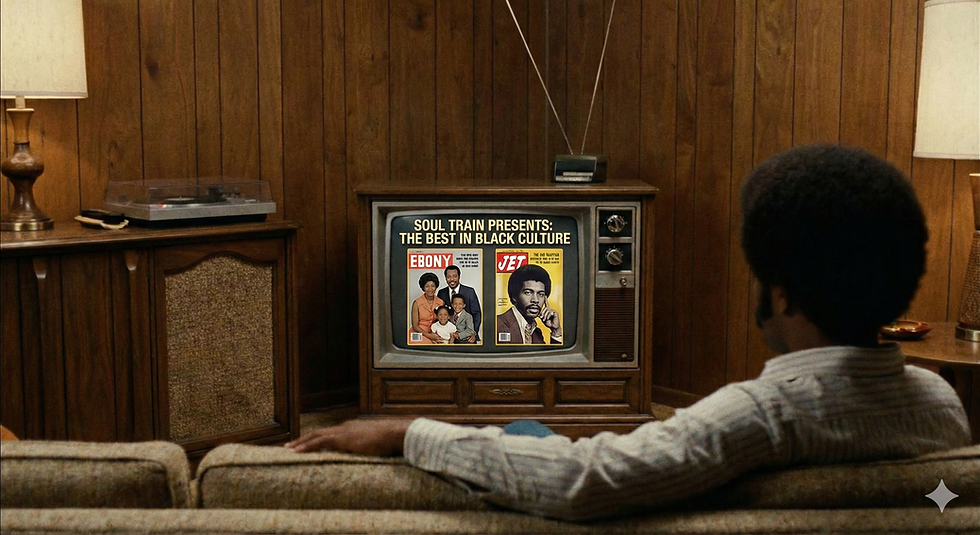
Ebony, launched in 1945, was not just a magazine; it was a rebuttal. Printed on glossy paper, it mirrored Life magazine but featured Black judges, scientists, and debutantes. It established a new evidentiary standard for Black humanity. In a court of public opinion that viewed Blackness as a badge of poverty, Ebony presented exculpatory evidence of wealth and class.
3.2 Jet: The Pocket Witness (1951)
Jet, launched in 1951, was the "Negro Bible." Small enough to fit in a pocket, it was the rapid-response unit of the Black press. It covered everything from socialite weddings to lynchings.
IV. Commercial Law: Breaking the Zenith Bar
The most significant piercing of the racial veil occurred in the realm of contract and advertising law. In the 1940s, corporate America operated under the "General Market" doctrine, which assumed Black consumers had no disposable income. This was a lie, and Johnson had the data to prove it.
Johnson targeted Zenith Radio Corporation. He discovered the CEO, Eugene McDonald, was obsessed with polar exploration and idolized Matthew Henson, the Black explorer ignored by history. Johnson used a rare autographed biography of Henson to gain access, a brilliant move of interpersonal equity.
He presented the data: Black consumers were buying Zenith radios despite the company’s refusal to acknowledge them. McDonald, impressed, overruled his marketing department. Zenith became the first major general market advertiser in Ebony. This was the moment the "color line" in American advertising was breached, not by statute, but by the sheer force of capitalism.
V. Fashion Fair: Intellectual Property and the "Ashy" Defense
5.1 The Failure of the Market
The origins of Fashion Fair Cosmetics lie in a failure of the duty of care by major cosmetic houses. Models for the Ebony Fashion Fair struggled to find makeup for melanated skin. They were forced to mix existing shades, a process known as "mixing", to avoid the "ashy" look.
Duty of Care: A fiduciary or quasi-fiduciary duty... to act with the watchfulness, attention, caution, and prudence that a reasonable person in the circumstances would use. Black’s Law Dictionary (11th ed. 2019).
Estée Lauder and Revlon breached this duty to Black consumers, refusing to manufacture dark shades. They claimed the market was de minimis.
5.2 The Trademark Solution
Johnson launched Fashion Fair in 1973. His distribution strategy was a masterclass in leverage. He refused to sell in drugstores. He demanded counter space in high-end department stores like Marshall Field’s. His leverage? The advertising pages of Ebony. If a store wanted to reach the affluent Black consumer, they had to carry Fashion Fair. By 2003, the brand generated over $50 million in annual revenue.
VI. The Litigation Docket: Defending the Narrative
JPC was not just a publisher; it was a litigant. The company fought battles that set precedents in privacy, libel, and the right of publicity.
6.1 Kelly v. Johnson Publishing Co. (1958): The Privacy of the Dead
In Kelly v. Johnson Publishing Co., 160 Cal. App. 2d 718 (1958), JPC faced a suit regarding an article about a deceased boxer, Jack Thompson. Ebony described him as a "dope-sodden derelict." His sisters sued for invasion of privacy.
The Court ruled in favor of JPC. The holding was brutal but legally sound: the right of privacy is a personal right that dies with the individual.
Right of Privacy: The right to be let alone; the right of a person to be free from unwarranted publicity. Black’s Law Dictionary (11th ed. 2019).
This ruling protected the press's ability to speak the truth about the dead, even if that truth was ugly.
6.2 Johnson Publishing Co. v. Davis (1960): The Cost of Hearsay
In Johnson Publishing Co. v. Davis, 271 Ala. 474 (1960), Jet got sloppy. They published a blurb claiming a teacher, Edward Davis, had been charged with sex relations with students. It was hearsay. The Supreme Court of Alabama upheld a libel judgment against JPC.
Libel: A defamatory statement expressed in a fixed medium, esp. writing but also a picture, sign, or electronic broadcast. Black’s Law Dictionary (11th ed. 2019).
The lesson? Being a voice for the community does not exempt you from the rules of evidence.
6.3 Toney v. L'Oreal (2005): The Right of Publicity
In Toney v. L'Oreal USA, Inc., 406 F.3d 905 (7th Cir. 2005), the issue was the exploitation of a Black model's visage. June Toney had modeled for Johnson Products (culturally linked to JPC). When L'Oreal acquired the brand, they kept using her face after her contract expired.
The Seventh Circuit ruled that the Illinois Right of Publicity Act protected Toney. Her "persona" was her property. This was a crucial victory against the commodification of Black bodies by white corporations.
VII. The Emmett Till Photos: The First Amendment as a weapon
There is no legal analysis of JPC without discussing the 1955 issue of Jet that published the photos of Emmett Till.
Mamie Till-Mobley wanted the world to see what white supremacy had done to her son. She issued a mandate. Jet photographer David Jackson executed it. The publication of the mutilated face of a 14-year-old boy was not "obscene" under the law; it was probative.
It provided visual evidence of the crime of lynching to a jury of millions. It shocked the conscience. It is widely cited as the spark for the Civil Rights Movement. In this instance, JPC acted as a vigilante press, doing what the courts refused to do: indict the guilty.
VIII. The Insolvency: Chapter 7 and the Liquidation of History
8.1 The Digital disruption
The internet killed the monopoly. The Root and Black Twitter provided for free what Jet sold for a dollar. JPC failed to pivot.
8.2 The Bankruptcy Filing (2019)
In April 2019, JPC filed for Chapter 7 bankruptcy. Unlike Chapter 11 (reorganization), Chapter 7 is a funeral. It is liquidation.
Chapter 7: A chapter of the Bankruptcy Code providing for the liquidation of a debtor's assets and the distribution of the proceeds to creditors. Black’s Law Dictionary (11th ed. 2019).
The assets were sold off. The headquarters at 820 S. Michigan Avenue, the fortress of Black power, was already gone, sold in 2010 for approx. $8 million.
8.3 The Archive Rescue
The 4 million-image archive was the soul of the company. It risked being auctioned piecemeal. A consortium (Ford, Getty, MacArthur, Mellon) intervened, purchasing it for $30 million to donate to the Smithsonian. This was a massive Charitable Contribution structure that saved history from the auction block.
IX. Conclusion: The Verdict
The Johnson Publishing Company is no longer the monolith it was. The assets are scattered. Ebony and Jet are now owned by the Bridgeman family (acquired for $14 million). Fashion Fair is at Sephora.
But the verdict is clear. John H. Johnson did not just build a business; he built a jurisdiction. He created a space where Blackness was the norm, not the exception. He used the tools of contract, property, and tort law to carve out a sanctuary. The papers are signed, the assets liquidated, but the precedent stands.
Matt Murdock, Esq.
Daley Center, Chicago


Comments